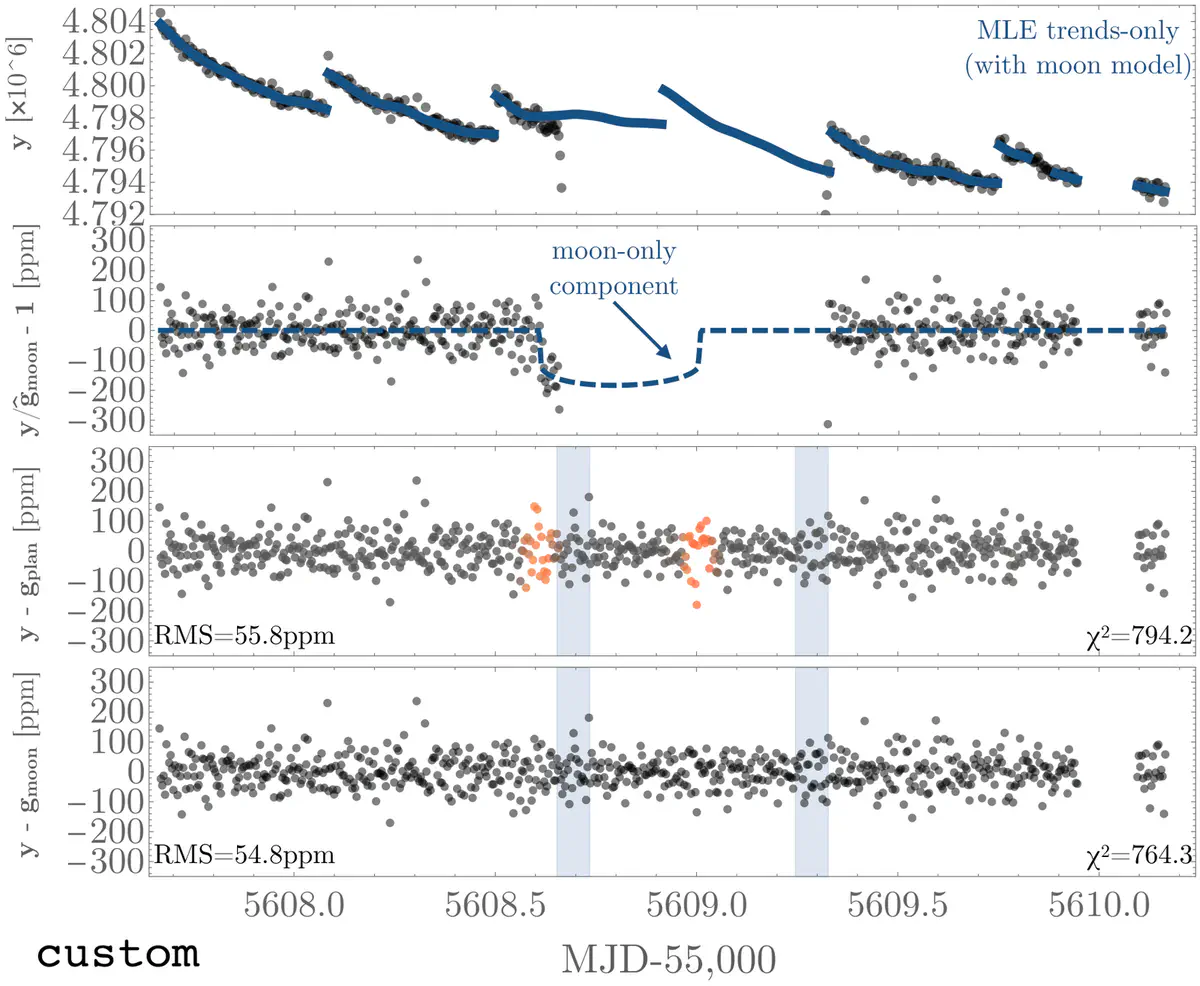
 Figure from the paper – Image credit: D. Kipping
Abstract
We present a search for exomoons around the Jupiter-like exoplanet Kepler-167e using a NIRSpec JWST transit. Our 60 hr time series clearly reveals the enormous impact of long-term trends in NIRSpec data, specifically a gradual flux drift occurring over each of six 10 hr exposures. We weighed the evidence for exomoons by comparing a planet-only model with a planet+moon model for a grid of twelve different analysis choices. Our grid was comprised of three different reduction pipelines and four different models for the exposure-long trends—two using linear models and two using Gaussian processes. Seven grid realizations indicate a strong exomoon detection, typically favoring a Roche-skimming orbit roughly 10% the size of the planet. We find that the only likely real astrophysical feature driving these fits is a syzygy-like event occurring almost exactly mid-transit, which is highly ambiguous with a spot-crossing event. Indeed, we show that a spot of the necessary size is compatible with the earlier Kepler data. Ironically, the fact that JWST is so superior to Kepler means that our fits are effectively driven by a single transit—a regime in which exomoons have enormous freedom to explain non-Gaussian behavior. We thus strongly urge the next transit be observed in 2027 October to break these degeneracies. Our pilot study to seek transiting exomoons with JWST reveals the profound impact exposure-long trends exert—a cautionary tale for future analyses of these data—as well as the need for a deeper understanding of the cause of these systematics and modeling best practices.

Quentin Changeat
Assistant Professor
I am interested in interpretation of exoplanet atmospheres from observations.